You’re offline, but every Efiwe page you’ve loaded — including this one — is still available.

Efiwe’s Offline Tutor and Read Aloud Get a Big Upgrade

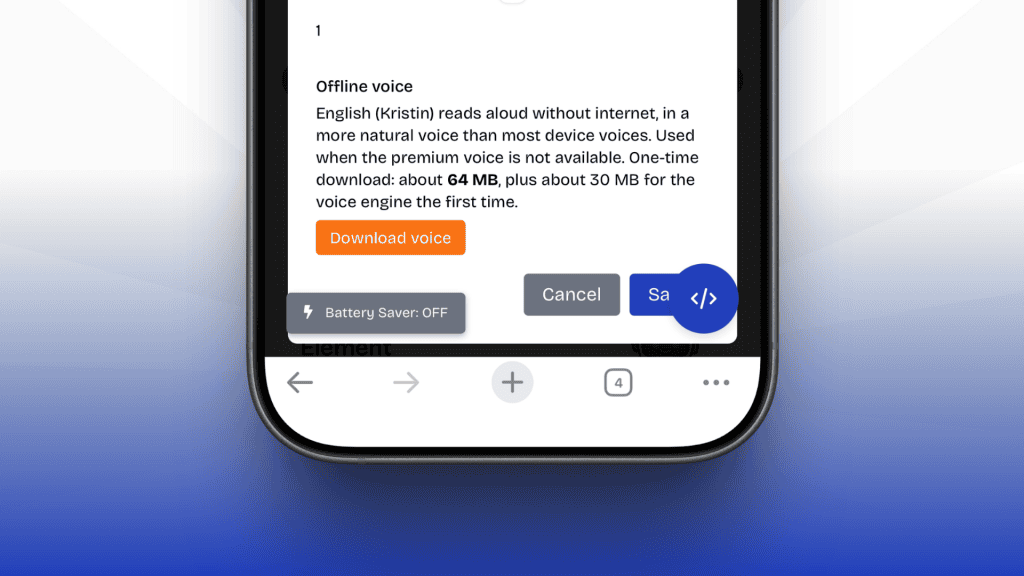
Efiwe has worked offline since day one. Today we are upgrading the two things learners lean on most when the connection drops: the AI tutor and Read Aloud. You can now download one of ten AI models that run on your phone, and natural-sounding offline voices for Read Aloud. Until now, learning offline meant Efiwe 1.5, our on-device model that checks your code and explains your mistakes, while Read Aloud used your phone’s built-in voice whenever ElevenLabs was not available. Efiwe 2.0 in the cloud gave the richest explanations, but only online. This release brings fuller explanations and a more natural voice to learners with no connection, and takes nothing away.
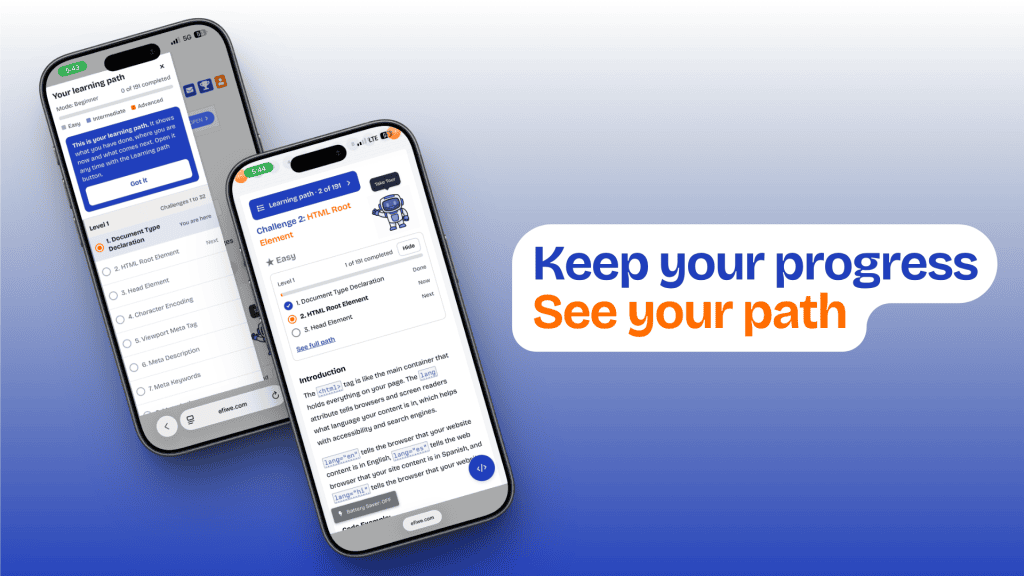
Keep your progress, see your path: what is new on Efiwe

Over the past two days, Efiwe shipped a set of updates that all come from the same place: what learners told us. A learner should never lose the work they have done, and should always be able to see where they are and what comes next. This is everything that changed, across all eight courses. Efiwe has three learning modes. Beginner takes every challenge in order. Skipper lets a learner skip what they already know. Explorer lets them pick the challenges they want. Until now, changing mode part-way through a course sent the learner back to the very beginning, and their points, badges and completed challenges were wiped. Learners complained about this, and they were right.

Efiwe Joins the NVIDIA Inception Program

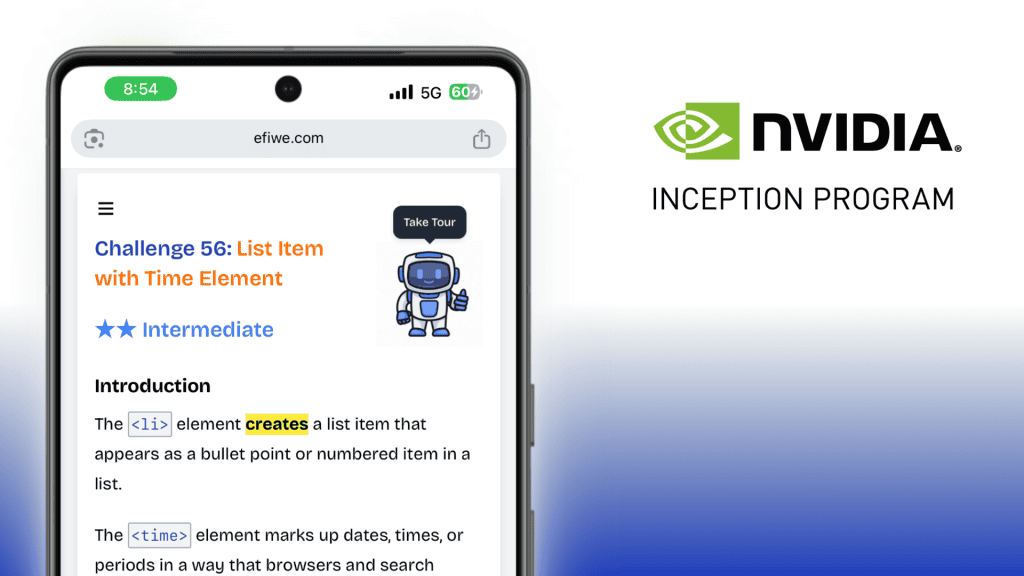
Efiwe AI has joined the NVIDIA Inception program, NVIDIA’s program for startups building with AI and accelerated computing. For many companies, Inception is a starting point. For us, it formalizes a relationship that already lives in our code. Efiwe exists because talent is everywhere, but access to coding education is not. Many of our learners code on low-end phones, with limited data and intermittent power. Every technical decision we make starts with them. That is why Efiwe runs on two AI models. Efiwe 1.5.1 (TensorFlow-based) runs entirely on the learner’s device, so it can grade code and give feedback with no internet connection at all. A learner in a classroom without Wi-Fi still gets a tutor.

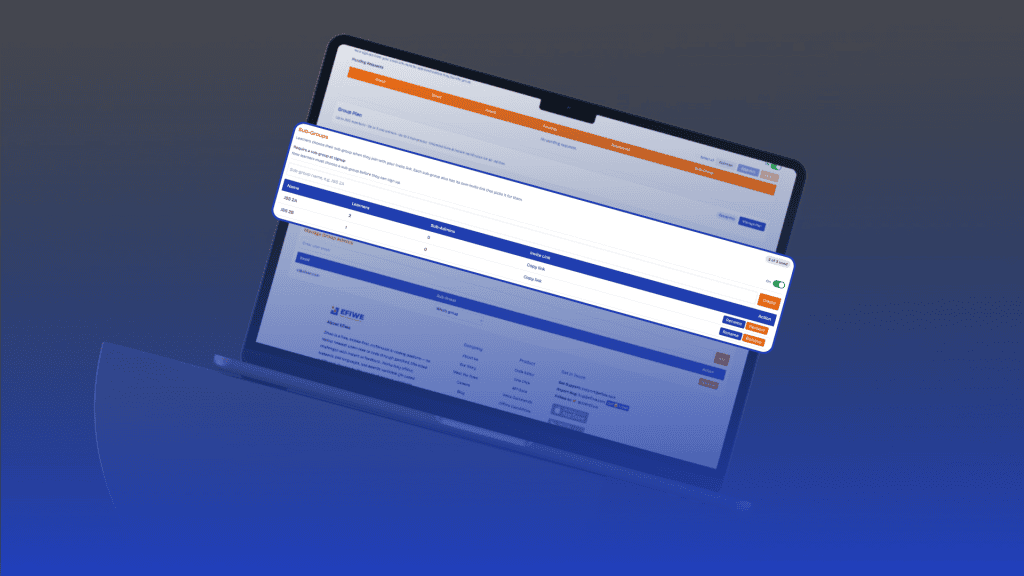
Introducing Sub-Groups: One Efiwe Group, Many Classes

Since Group Accounts launched, schools, NGOs, bootcamps, teachers and community programmes have used Efiwe to run structured coding education across Nigeria, India and beyond, with learners working entirely on their smartphones and no computer lab required. As these groups have grown, one request has come up again and again. A school rarely teaches coding to one big room. It teaches JSS 2A and JSS 2B, the Saturday club and the after-school cohort, each with its own teacher and its own pace. Until now, every learner in an Efiwe group sat in a single list, and every sub-admin saw everyone. Today we are changing that with Sub-Groups. Sub-Groups let a group owner divide their group into classes, cohorts or teams, assign a sub-admin to each one, and give that sub-admin a dashboard built entirely around their own learners. The owner still sees the whole group, while each teacher sees only the students they are responsible for.

Efiwe Selected for Google for Startups Immersion EMEA

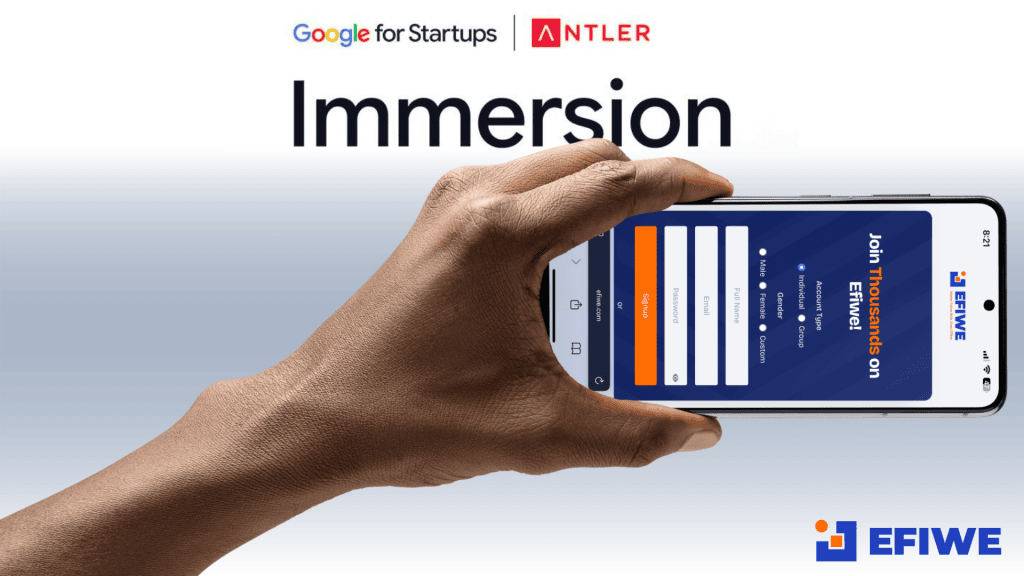
We’re thrilled to share some exciting news: Efiwe has been selected to take part in Google for Startups Immersion EMEA, a program delivered in partnership with Antler. It’s a milestone we’re proud of, and one that reflects the progress our team and our community of learners have built together over the past year. Google for Startups Immersion EMEA is a structured program designed to support high-potential startups across Europe, the Middle East, and Africa. It runs in two phases. We’ve been confirmed for Phase 1: Online, a week-long series of masterclasses running from October 22nd through the 28th. During that week, founders selected for the program will get access to hands-on technical sessions, mentorship from experienced operators, and a community of peers building at a similar stage, all delivered live, with real-time Q&A built into every session.

Efiwe Adds Capstones, and Makes Them a Condition of Certification

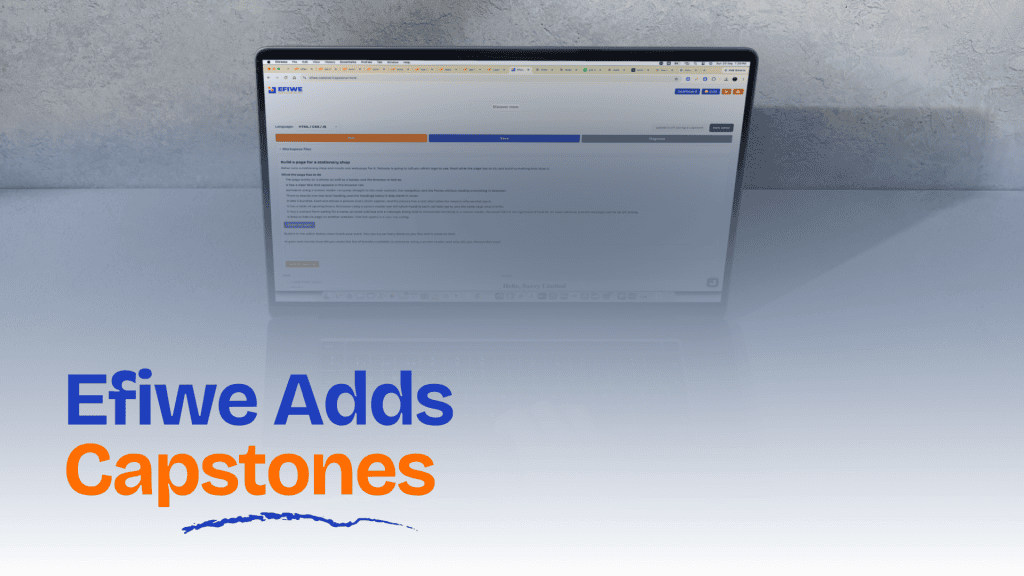
Efiwe has added a capstone project to the end of all seven of its coding courses, and made passing it a requirement for a Certificate of Completion. Learners build from a written brief with no worked example available, in Efiwe’s IDE rather than the challenge screen. Their work is run and tested automatically against the requirements, and the certificate unlocks only if every one is met. Attempts are unlimited and cost no lives. Efiwe today announced Capstones, a change to how the platform certifies that a learner has actually learned something. Until now a certificate rested on points, which reward persistence and correctness across hundreds of challenges. But every Efiwe challenge shows a worked example a few lines above the editor. Most learners use it to understand the pattern. Some copy it. The platform had no way of telling the two apart, and neither did anyone reading the certificate afterwards.