

Efiwe has added a capstone project to the end of all seven of its coding courses, and made passing it a requirement for a Certificate of Completion. Learners build from a written brief with no worked example available, in Efiwe’s IDE rather than the challenge screen. Their work is run and tested automatically against the requirements, and the certificate unlocks only if every one is met. Attempts are unlimited and cost no lives.
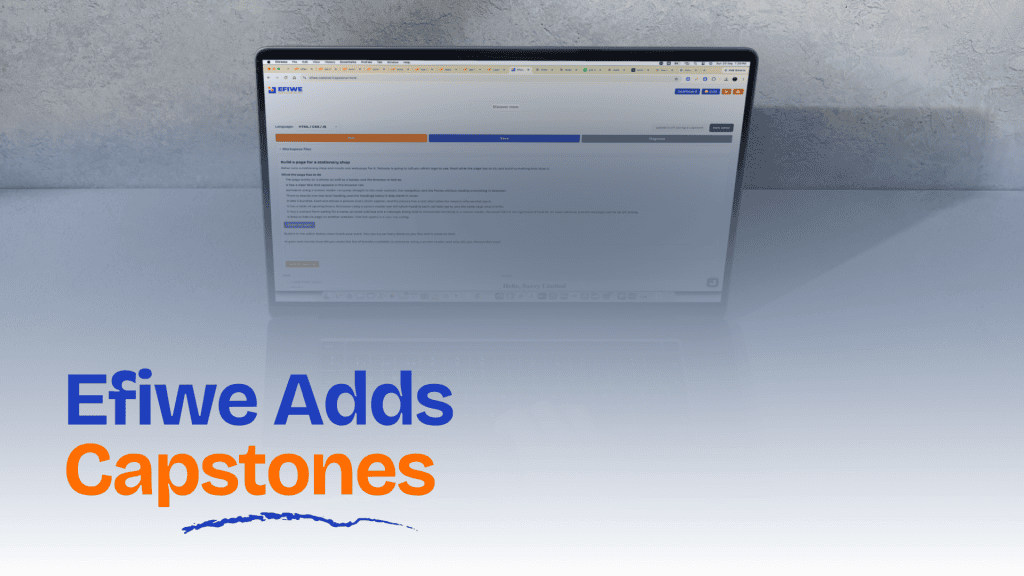
Efiwe today announced Capstones, a change to how the platform certifies that a learner has actually learned something. Until now a certificate rested on points, which reward persistence and correctness across hundreds of challenges. But every Efiwe challenge shows a worked example a few lines above the editor. Most learners use it to understand the pattern. Some copy it. The platform had no way of telling the two apart, and neither did anyone reading the certificate afterwards.
A capstone closes that gap. At the end of a course, a learner opens a brief describing what a page, a program or a database has to do. It states requirements rather than instructions: “someone using a screen reader can jump straight to the main content” rather than “use a <main> element”. Which tag, function or query achieves that is the thing being assessed.
Every brief is graded mechanically. The HTML capstone inspects the page the browser actually built. The CSS and Tailwind ones read computed styles and measure the layout at phone and desktop widths, so a media query that does nothing cannot pass. The JavaScript capstone types into the form, submits it, clicks the remove button and checks what the page became. Python and PHP run the learner’s functions against inputs they have never seen. SQL runs their queries against the dataset in the brief, and then against a second dataset nobody is shown: real queries survive that, hardcoded answers do not.
“Points measure effort, and effort matters, but it is not the same as ability,” said Chidi Nwaogu, Co-founder and CTO of Efiwe. “We were issuing a document that said somebody could build a website, on evidence that only showed they had finished a course. Those are different claims.” He added, “The rule I set for myself was that our cloud AI must never decide whether someone passes. It reads the learner’s written explanation and offers a comment, but the pass or fail comes from running the code locally.”
Briefs vary per learner. Each course generates 72 combinations of subject and scale, so a classroom of thirty receives thirty different tasks and the answer to one is not the answer to another. Passing also requires a short written explanation of how the learner solved it, on the reasoning that pasted code and an explanation of that code rarely match.
Attempts are unlimited and do not consume lives, and a learner who has already passed cannot lose that by trying again for practice. The intention is to establish that someone can do the work, not to catch them out once. During a capstone the editor accepts text copied from within the page but not from elsewhere, and file uploads are turned off, so an answer written in another tab cannot simply be dropped in.
Capstones work offline, like the rest of Efiwe. Results sync when a connection returns, and a learner who passes on a shared classroom phone with no data keeps that pass.
Learning Modes, released earlier this month, made this more necessary rather than less. Skipper and Explorer both let learners past challenges without solving them, which widened the distance between finishing a course and being able to do the work. A capstone measures the same thing in all three modes, so the certificate no longer depends on which one a learner chose.
Capstones are available immediately on the HTML, CSS, Tailwind, JavaScript, Python, SQL and PHP courses at efiwe.com. Prompt Engineering does not yet have one.
or