

Efiwe is one of 16 innovations chosen from across 11 African countries to compete for a share of the £85,000 Africa Prize fund; the continent’s largest prize dedicated to engineering innovation.
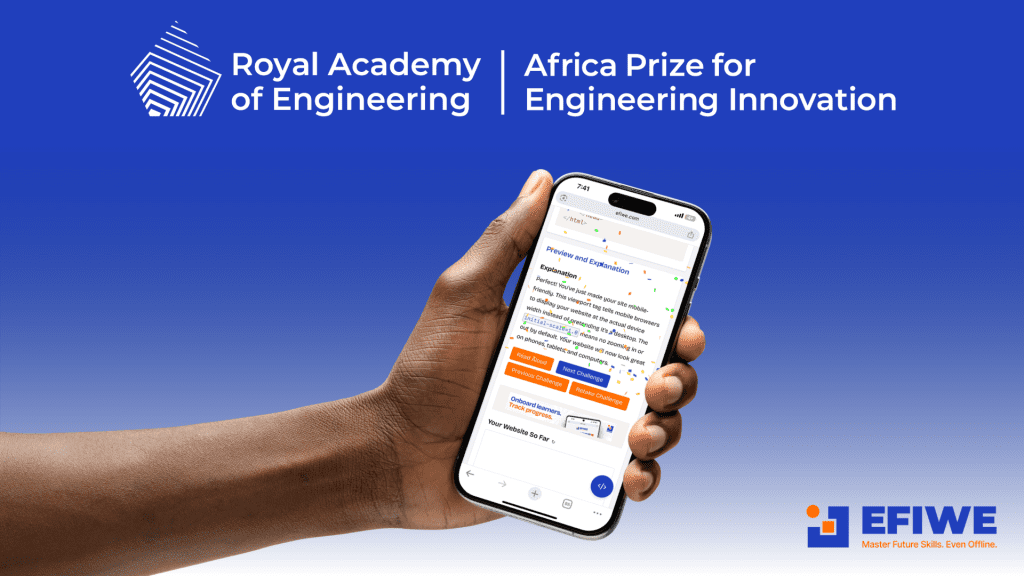
The Royal Academy of Engineering has shortlisted Efiwe for the 2026 Africa Prize for Engineering Innovation, recognising it as one of the most impactful engineering solutions on the African continent. Efiwe joins 15 other innovators from Ghana, Kenya, Lesotho, Malawi, Niger, Rwanda, Senegal, South Africa, Tanzania, and Zambia (including innovations in mobile dialysis, AI-powered cardiac screening, clean water access, smart agritech, and renewable energy) in competing for a share of the £85,000 prize fund. The winner receives £50,000, with three runners-up each awarded £10,000.
The Africa Prize, part-funded by the UK’s Department for Science, Innovation and Technology, is the largest engineering innovation prize in sub-Saharan Africa. Since its founding in 2014, the Prize has supported 165 businesses across 22 countries, collectively employing more than 40,000 people and benefiting more than 11 million people through their products and services. This year’s shortlist attracted a record number of applications from more than 30 countries, and marks the first time innovators from Lesotho and Niger have been included.
Efiwe was selected for its approach to one of the most persistent and overlooked problems in global education: the billions of people locked out of coding education simply because they do not own a laptop or live in an area with reliable internet.
Built on the belief that talent is everywhere but opportunity is not, Efiwe is a mobile-first coding platform that runs entirely on basic smartphones, works completely offline once loaded, supports 189 languages, and is free at its core. Launched on August 16, 2025, the platform has since grown to more than 10,000 learners across 121 countries. Its AI tutor gives personalised, instant feedback on every single coding challenge; not generic hints, but feedback informed by how long the learner has been stuck, what mistakes they have made before, and how they are progressing in real time.
The platform’s approach has already produced results that stand apart from the industry norm. When the typical online coding course loses 70–80% of its learners before they finish, every person in Efiwe’s focus group completed the entire course. 89% felt confident building websites independently afterward. 100% said they would recommend Efiwe to a friend.
The platform today offers four complete courses (HTML, CSS, JavaScript, and Tailwind) with Python, PHP, SQL, and React on the way. It has expanded beyond its core web platform to Facebook Messenger and WhatsApp, allowing learners to access the full curriculum and AI feedback without downloading anything at all. For organisations, Efiwe’s Group Accounts and Open API make it possible to run structured, measurable coding education at scale across schools, NGOs, and bootcamps, without a single computer lab.
Efiwe’s co-founder and CTO, Chidi Nwaogu, knows the problem intimately from both sides. As Academy Director at an African-focused edtech organisation, he watched students join class, engage actively, and then quietly disappear, not by choice, but because their internet was too unreliable to stay connected. Of 80 students enrolled, only 6 graduated. That experience, combined with Abhinav’s parallel reality running coding bootcamps in remote Himalayan villages where students had no laptops and no internet, became the foundation for everything Efiwe is built to be.
As part of the Africa Prize programme, Efiwe will now enter an eight-month training and mentoring journey focused on scaling the business; covering financial management, market analysis, technical mentoring, and access to the Academy’s network of engineers and business leaders across the UK and Africa. Four finalists will be selected to pitch at a live final in Johannesburg in October 2026, where the winner and a People’s Choice award will be announced.
For Efiwe, this recognition is more than a milestone. It is validation that a coding platform built from the ground up for people without laptops, without stable internet, and without English as a first language belongs at the very top of the conversation about what engineering innovation can look like and who it can serve.
or