

The mobile-first coding education platform expands its reach by embedding its interactive coding challenges directly inside the world’s two most popular messaging apps, building on the Open API it launched in January 2026.
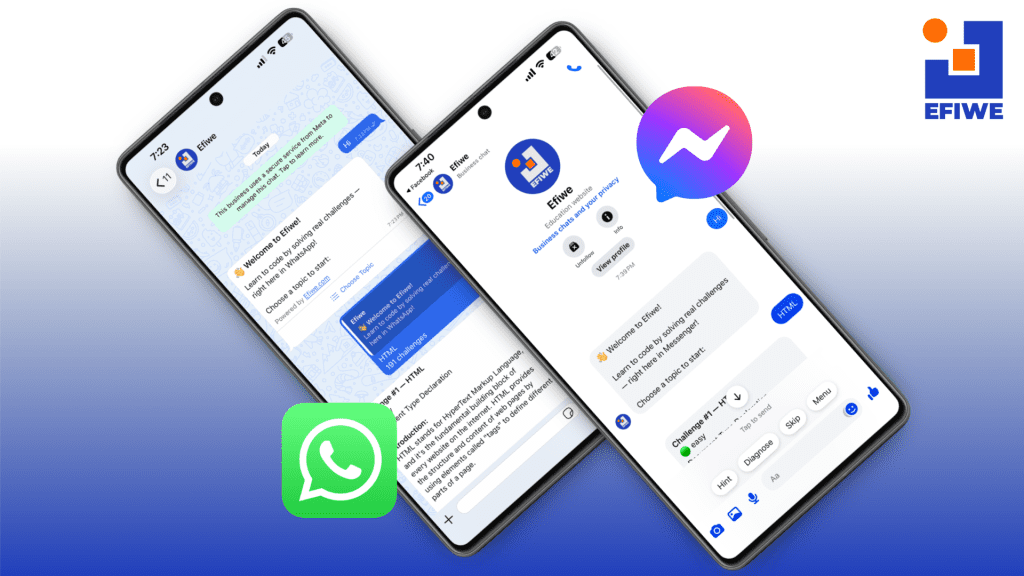
Efiwe, the mobile-first coding education platform serving over 10,000 learners across 121 countries, has extended its learning experience to Facebook Messenger and WhatsApp, allowing anyone to learn to code without leaving their favourite messaging app. Starting today, users can simply send a ‘hi’ message to the Efiwe Facebook Page or WhatsApp Business number and immediately begin solving real coding challenges, receiving AI-powered hints, and getting instant feedback on their code, all within the same interface they already use to chat with friends and family.
This expansion is a direct extension of the Efiwe Open API, which launched in January 2026 and was specifically designed to allow third-party platforms to embed Efiwe’s interactive coding challenges (or their custom challenges) into their own products. The Messenger and WhatsApp bots are built entirely on top of that API, using the same challenge delivery, code validation, hint generation, and AI-powered diagnostics that power the main Efiwe platform. In this sense, the bots are not a separate product but a proof of concept for what the Open API makes possible: world-class coding education delivered inside any platform, without rebuilding any of the underlying technology.
The experience is designed to feel natural within each platform. On Facebook Messenger, users tap interactive buttons to choose their topic and navigate between challenges, hints, and diagnostics. On WhatsApp, the bot uses list menus and reply buttons that feel native to the app, with the four course topics (HTML, CSS, JavaScript, and Tailwind) presented as a clean, scrollable selection. In both cases, the bot remembers where a user is in their learning journey within a session, presenting challenges progressively and loading the next one automatically once a correct answer is submitted.
The AI-powered feedback that defines Efiwe’s main platform travels intact to both bots. When a user submits code, the bot first validates it, then generate a short, context-aware sentence of feedback. If the cloud-based AI (Efiwe 2.0) is unavailable, the system falls back seamlessly to the on-device AI (Efiwe 1.0), ensuring learners always receive a reply. The same layered fallback logic applies to hints and code diagnosis, where the Efiwe 2.0 model is always attempted first, with the 1.0 model ready as a backup.
“Efiwe was built on the belief that the barrier to coding education should be zero,” said Chidi Nwaogu, Co-founder and CTO of Efiwe. “Most of our learners are already on WhatsApp every single day. Asking them to visit a new website is friction we don’t need to create. If we can bring the learning to where they already are, we should.”
The timing of this launch reflects a broader strategic direction for Efiwe. The Open API was built explicitly so that schools, NGOs, bootcamps, and developers could embed Efiwe’s curriculum into their own platforms without rebuilding its technology. The Messenger and WhatsApp bots demonstrate that this integration can go far beyond websites and apps, reaching into the messaging layer of the internet where billions of people already spend hours every day. For learners in communities where smartphones are their primary device and messaging apps are their primary gateway to the internet, this means coding education is now available in the most accessible place imaginable.
Efiwe’s Messenger and WhatsApp bots are available now. Users can access the Messenger bot by messaging the Efiwe Facebook Page, and the WhatsApp bot by messaging the Efiwe WhatsApp Business number. Both bots are free to use and require no account creation, no downloads, and no prior coding experience to get started.
or