

Nigeria and India have both made big promises about coding in schools. Nigeria made Digital Literacy & Coding a compulsory subject in junior secondary school. India’s national education policy said students should learn coding from Class 6.
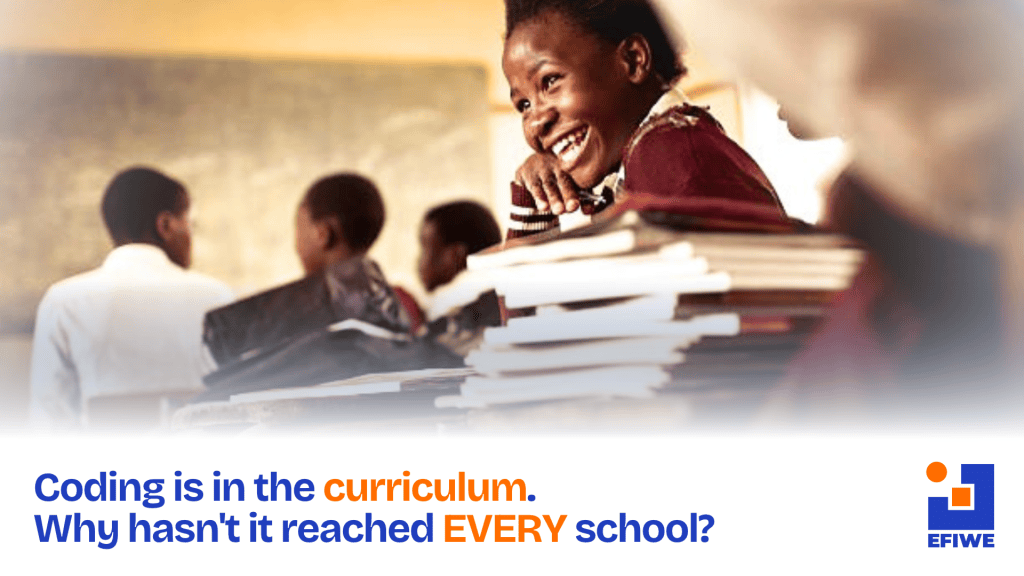
These are good policies. But years later in India, and more than a year later in Nigeria, most public school students still are not learning to code. Maths, English and Science reach almost every school. The new coding plans do not, at least not yet. We work with public schools in both countries, so we see this gap up close.
This article looks at why these policies have not reached every school, and what could help them get there faster.
What was promised, and how far it has gone
Nigeria. The new curriculum started in September 2025. In JSS, it includes basic Python, Scratch and simple robotics (BusinessDay). It is being rolled out one class at a time. The first year covered JSS 1 and SS 1, and September 2026 added JSS 2 and SS 2 (TEQAD conference notes). The start was rough. When the session began, many schools, and even some state officials, had never seen the new curriculum (HeadTeacher.ng). Six months later, schools still had not received the teaching schemes they needed, and some were told to keep using the old ones (The Whistler).
India. NEP 2020 is six years old. But education in India is shared between the central government and the states, so the NEP needs each state to carry it out (Anantam IAS). Each state decides how fast to move (IMPRI). The CBSE board added coding quickly, but CBSE covers only about 30,415 schools (Rajya Sabha). India has more than 1.47 million schools in total (Education for All in India). So CBSE’s choices reach only about 2% of them. The rest depend on their state. Some states are moving. Uttar Pradesh, for example, plans to teach coding basics to more than 5 million students in about 45,000 state-run schools (The Hans India).
Why it has not reached every school
Maths and English spread to every school decades ago. Teachers, textbooks and exams for them already exist everywhere. A new subject like coding has to build all of that from scratch, at the same time. Here is where it gets stuck.
1. The rollout came before the materials. In Nigeria, schools started a new session without textbooks or guides for teachers. One group called for the curriculum to be paused until textbooks were produced and teachers trained (DSM). Experts warned that rural schools lacked the facilities and staff, while schools in Lagos and Abuja would benefit most (BusinessDay).
2. There are not enough trained teachers. Nigerian teachers say coding specialists are few, and posting them to rural schools is hard (Leadership). Nigeria has over 50,000 secondary schools to cover (Leadership). India faces the same problem on a bigger scale. A parliament panel flagged around 1 million teaching vacancies, and 36% of government schools had fewer than 50 students with only one or two teachers (SPRF). A school with two teachers cannot easily add a coding teacher.
3. Many schools have no computers. Fewer than 30% of Nigeria’s public secondary schools have a working computer lab (AllAfrica). A UBEC census found that 89% of private urban schools teach computer studies, but only 12% of public rural schools do (The Guardian). In India, about 65% of schools had computers in 2024-25 (Ministry of Education). But in Bihar, only 16.5% of government schools did, against 72% of private schools (ThePrint).
4. Power and internet are unreliable. In India, internet access is about 58.6% in government schools against 77.1% in private schools (Education for All in India). In Nigeria, a widely cited 2017 estimate said about 65% of public primary and junior secondary schools lacked electricity (The Guardian).
5. The exams have not changed yet. Schools teach what students will be tested on. In Nigeria, BECE and SSCE will be based on the old curriculum until 2028 (The Whistler). Until coding is examined, many schools will put it last.
Put together, these problems hit the same students hardest: those in public, rural and poorer schools. That is why the gap between private and public schools keeps growing, even with good policies on paper.
What would help these policies reach every school
Building a lab and hiring a coding teacher for every school would take many years and huge budgets. That work should continue. But students in school today cannot wait for it. Here is what can speed things up:
- Use the phone, not the lab. Most families already own a phone. A coding platform that runs on a phone, works offline and is free removes the computer and power problem for most students.
- Let any teacher run the class. If the platform does the teaching and checks every answer, a regular teacher can guide students without being a programmer. That eases the teacher shortage right away.
- Give schools ready-made materials. A complete course, ready on day one, means schools do not have to wait for textbooks or teaching schemes.
This is how Efiwe works in public schools in Nigeria and India. Students learn on phones, often shared ones. Teachers use a dashboard to see who is stuck and who is ready for more. At one Lagos girls’ school, 41 students completed 12,323 challenges across six courses this way.
From paper to every classroom
Nigeria and India have made the right decision. Coding is now in the plan. The hard part is reaching every school, not only private schools and big cities. That will not happen through policy alone. It will take governments, schools, teachers and partners working together, and using the tools students already have in their hands.
That is the job Efiwe was built for. It turns the phone a student already has into a coding classroom. It works offline, is available in 246 languages, and every course is free. Any teacher can run a class, because Efiwe teaches, checks every answer and shows the teacher who needs help.
We are already doing this with governments, not around them. In Lagos, we work with Education Districts II and IV in ten public senior secondary schools, and with Teach For Nigeria in ten more schools across Lagos and Ogun state. In India, we have run school pilots in Uttarakhand.
The policies are ready. The students are ready. Efiwe helps close the distance between the two, one school at a time.
or