

In August 2026, we started a coding programme at New Era Girls’ Senior Secondary School in Surulere, Lagos. Forty-one girls joined. We gave them one course to finish: HTML, with 191 challenges.
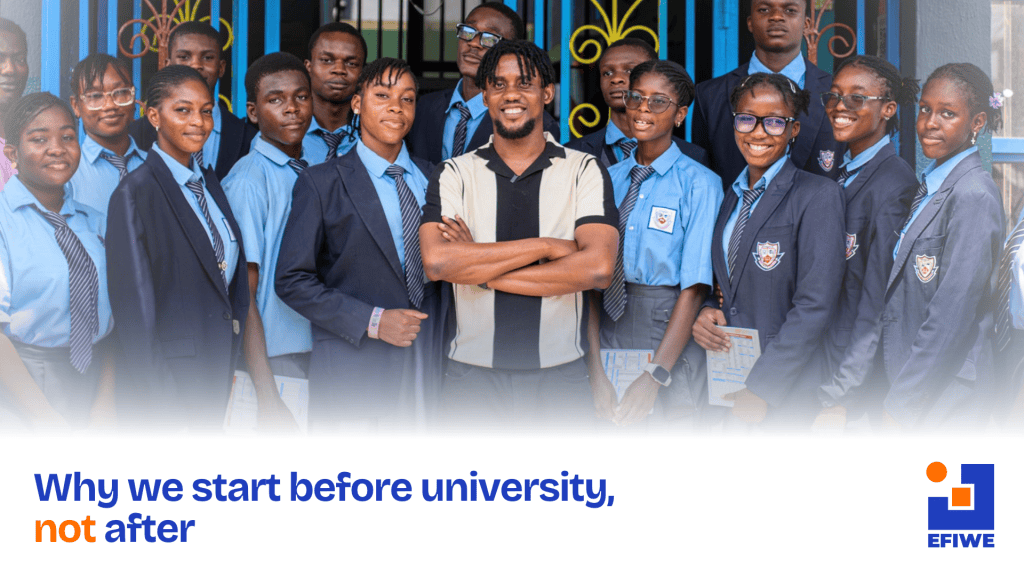
Twenty-one girls finished all of it. Nobody asked them to do more, but many kept going. Twenty-two started the CSS course, and ten finished all 298 challenges. Four girls finished all 488 JavaScript challenges, our hardest course. Others tried Tailwind, Python and SQL.
Altogether, the girls completed 12,323 challenges across six courses. Two of them completed more than 1,200 each. They got no extra marks for this. They practised during break time, after school and at home, mostly on phones they shared with family.
Two months after the programme ended, some of them are still learning.
People often ask us why Efiwe focuses so much on secondary school students, especially those in public schools. These girls are a big part of the answer. Here is the rest.
For many students, secondary school is the last classroom
Every year, millions of Nigerian students finish secondary school. Only some of them get into university.
In 2025, almost 2 million students wrote WAEC (Premium Times). That same year, about 2 million people wrote JAMB, and about 1 million got admission into a university, polytechnic or college of education (Legit.ng).
That was the best year in a long time. Still, almost 1 million people who wrote JAMB did not get a place (The Guardian). In 2021, fewer than 1 in 4 got in.
And these numbers only count people who wrote JAMB. Many students never write it at all. Some get admission but cannot pay the fees, rent or transport. Others stay at home for one, two or more years, writing JAMB again and waiting.
This is not because these students are not smart. It is because there are not enough university spaces, and university costs too much for many families. But the result is the same. For millions of young Nigerians, secondary school is the last classroom they will ever sit in. If we want them to leave with something useful, we have to reach them while they are still there.
Coding teaches you how to think
Learning to code is not really about memorising a programming language. It is about learning to solve problems.
When you write code, you take a big problem and break it into small steps. You try something. If it does not work, you find out why and fix it. Every Efiwe challenge asks learners to do this, again and again, hundreds of times. That habit is useful far beyond coding.
Research backs this up:
- When researchers looked at 105 studies together, they found that students who learn to code often get better at other kinds of thinking too, especially creativity, maths and understanding how they learn best (Scherer et al., 2019).
- A 2024 review of studies with more than 1,500 young learners found that coding helps them get better at planning ahead and solving problems (Montuori et al., 2024).
- Teenagers learn most when they actually write code themselves, even more than younger children do (Education and Information Technologies, 2022). That is exactly how Efiwe works. Learners write real code from their very first challenge.
To be fair, coding will not fix everything. It does not automatically raise grades in every subject, and researchers are still studying how far the benefits go. But it is one of the best ways to build clear thinking, and the teenage years are a great time to start.
A skill that can earn money later
Finding work is hard for young Nigerians. Official government figures say only 6.5% of people aged 15 to 24 were unemployed in mid-2024 (The Guardian). But those figures count you as employed even if you worked just one hour that week. A 2025 report by Plan International and ActionAid found that 53% of young Nigerians are unemployed (Legit.ng).
We want to be honest. A 15-year-old who finishes a coding course will not get a job the next day. But they will be years ahead of where they would have started.
A student who starts Efiwe in SS1 has enough time to learn a lot before leaving school:
- How to build websites, with HTML, CSS, JavaScript and Tailwind.
- How apps work behind the scenes, with Python, SQL and PHP.
- How to use AI to help build software, with Prompt Engineering.
They can finish school with real projects to show, and certificates with QR codes that employers can scan and check. The time spent at home waiting for admission is no longer wasted. They can use it to build things, take small paid jobs online, apply for internships, or prepare for a computer science degree.
Why public schools, and why phones
There are smart students in every school. But not every student has a laptop, a computer lab, data or a private lesson teacher. Most coding programmes need those things, so they mostly reach students who already have them.
We built Efiwe differently. It works on the phone a family already has. Once it is set up, it works without internet. It is available in 246 languages, and every course is free. The AI tutor lives inside the phone, so learning does not stop when data runs out.
We also work through schools, because that is where students are, and where teachers can guide them. We work with Teach For Nigeria in 10 schools in Lagos and Ogun State. We also work with Lagos State Education District IV in five public secondary schools, and Education District II in five more schools in Ikorodu. Teachers get a dashboard that shows which students are stuck and which ones are ready for more.
New Era is not our only success story. At Government College (Senior), Surulere, 54 boys joined. Eleven finished all 191 HTML challenges, and 9 of them started CSS on their own.
Starting early changes everything
We start in secondary school because that is where the gap begins. Some students will go to university. Many will not. But any student who leaves school knowing how to solve problems, write code and prove it with a certificate has more choices in life.
The girls at New Era did not need anyone to convince them. They only needed a chance. Our goal is to give that chance to every public school student in Nigeria and across Africa.
or