

Last month, Acumen published The last-mile AI gap, a piece by Dan Waldron, Acumen’s Director of Insights, on how social enterprises are actually using AI on the ground. It is one of the clearest descriptions I have read of the problem Efiwe was built to solve.
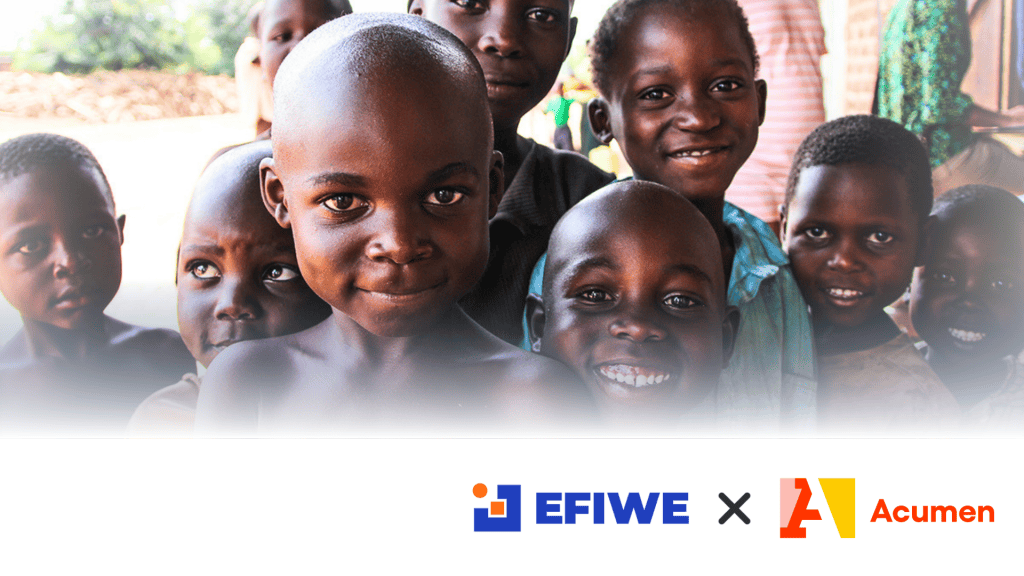
The article looks at two Acumen-connected companies: Haqdarshak, which helps Indian citizens access government welfare schemes, and Atram, a climate risk platform for lenders in Kenya and Colombia. Its central finding is a paradox. AI is making social enterprises more effective, yet the same gaps that kept poor and rural communities out of digital services before (infrastructure, money, language) are now keeping them out of AI. As Haqdarshak founder Aniket Doegar puts it, services are concentrating on “people who already have services.”
As an Acumen Fellow, I read the piece with particular interest. We work in education, not welfare or climate finance. But almost every barrier the article names is one we have spent the last 15 months engineering around.
The gap Acumen describes
The article puts it simply: “The future is here, but it has never been so unevenly distributed.” More than 2 billion people have never been connected to the internet. In India alone, about 600 million people are offline, overwhelmingly in rural areas.
The barriers compound. Rural communities are more likely to speak languages that have no strong AI models; Atram’s founder names Yoruba and Hausa as one of his biggest needs in West Africa. They are less likely to own a smartphone or be digitally literate. And they cost more to reach. Doegar explains that a field agent in Pune can deliver 50 services a day at a profit, while the same service in rural Uttar Pradesh costs 2.5 times more, and an agent manages 10 a week.
We recognised every one of these. Before Efiwe, I ran an academy where 80 students enrolled and only 6 graduated. They did not lack talent. They lacked laptops, and their connections kept dropping until continuing stopped being possible. My co-founder Abhinav saw the same thing in remote Himalayan villages, where students asked him: “Sir, we have neither a laptop nor the internet. How do we continue learning?”
Building AI for the last mile, not the first
Acumen warns that without action, the most vulnerable could be“steamrolled” by AI rather than benefiting from it. Efiwe’s answer was to design for the learner at the end of the line first, and treat everyone else as the easy case.
- No internet. Efiwe works fully offline after a single load. Our own AI tutor, Efiwe 1.5, is 1.4 MB and runs entirely on the phone, checking code and explaining mistakes with no connection. Since October, learners can also download one of ten external small language models and natural offline voices, so even the richest feedback no longer needs data.
- No smartphone. Efiwe Zero lets anyone learn to code over SMS on a basic feature phone, starting with MTN Nigeria users who text EFIWE to 34461.
- No English. Every challenge, hint and explanation is available in 246 languages plus sign language, including Yoruba and Igbo, which we validated with Teach For Nigeria. Since October, every challenge also comes in Simple Language for learners who struggle with wording rather than code.
- No money. The core platform is free. Learners who choose the on-device tutor get unlimited instant feedback at no cost.
- Shared phones and scarce power. Up to 20 learners can share one device, and Battery Saver Mode keeps lessons running when a charge has to last all day.
The result is that the cost of reaching a learner in a rural village is close to the cost of reaching one in a city. That is the reverse of the Pune and Uttar Pradesh problem Doegar describes. Today, more than 23,000 learners in 160 countries use Efiwe.
AI that strengthens trusted people
One of the article’s best insights comes from Karen Little of PayPal: “AI works best when it extends the reach of trusted people and institutions.” Haqdarshak did not replace its door-to-door agents with AI. It used AI to make them more effective, and their clearance rates doubled.
We hold the same view about teachers. Efiwe does not replace them; it gives every one of them a tutor for each student. Our largest deployments run through trusted institutions: Teach For Nigeria Fellows in 10 schools across Lagos and Ogun State, and five government senior secondary schools with Lagos State Education District IV. Group dashboards, daily AI-written summaries and weekly growth emails tell a teacher who has stalled, where, and which student is worth a call.
It works. At New Era Girls’ School in Surulere, 41 girls were assigned one course. They completed 12,323 challenges across six courses, many during breaks and at home on shared phones. At our second school, the cohort taught us the human side matters just as much: we now follow up within days, pair finishers with classmates, and measure growth with baseline and endline checks.
Atram keeps a human meteorologist in charge of weather warnings, because a false negative could be devastating. We apply the same principle. Efiwe 1.5 grades every submission deterministically, so a grade is always right and always the same. Language models only explain the facts it hands them; none of them decides whether a learner passes. In One Click, our job-search agent prepares applications overnight but never submits one without the person’s say.
The token problem, and why we moved AI onto the phone
Doegar makes a striking request in the article: concessionally priced AI tokens for social enterprises. Cloud computing got similar concessions years ago, he notes, but the gap has reopened with AI. Without it, companies serving the last mile “could get priced out.”
We feel this every day. Efiwe 2.0, our cloud tutor, gives the richest feedback, and every request costs money. That is why free learners have a five-minute cooldown on it. But we refused to let that cost decide who gets help. So we built the other half of the system to run where tokens cost nothing: on the learner’s own phone.
Efiwe 1.5 and the external on-device language models have no per-request cost, no cooldown, and send no data off the device. A learner on a metered bundle in a rural town gets unlimited, instant feedback. The cloud makes the experience better when it is available. It is never the only way in.
What we cannot solve alone
Acumen is honest that many of these barriers are “unlikely to be solved by a for-profit enterprise,” and we agree. Efiwe can work around a weak connection, but it cannot build a cell tower. Learners still need one initial load to go offline. Efiwe Zero currently runs on one network in one country. A learner still needs a phone, and women in many of our markets are less likely than men to own one.
That is why the article’s call for long-term funding in rural infrastructure, smartphone access, community support and local language models matters. Products like ours can stretch every megabyte and every dime as far as possible. Funders, governments and telecom partners can widen the road itself.
Closing the gap
The Acumen piece ends on a choice. Cheaper access to AI could create “a boom of last-mile service models,” or the companies serving that market could get priced out. At Efiwe, we have bet on the first outcome, and we have built for it: AI that runs offline, in the learner’s language, on the phone they already own, alongside the teachers they already trust.
Talent is everywhere, but opportunity is not. The last-mile AI gap is real. We think it can be closed, one learner and one challenge at a time.
If you run a school, NGO or programme serving last-mile learners, start a free group at efiwe.com, or embed Efiwe in your own platform through our Open API.
This article is written by Chidi Nwaogu, the Co-founder and CTO of Efiwe and an Acumen Fellow.
or