

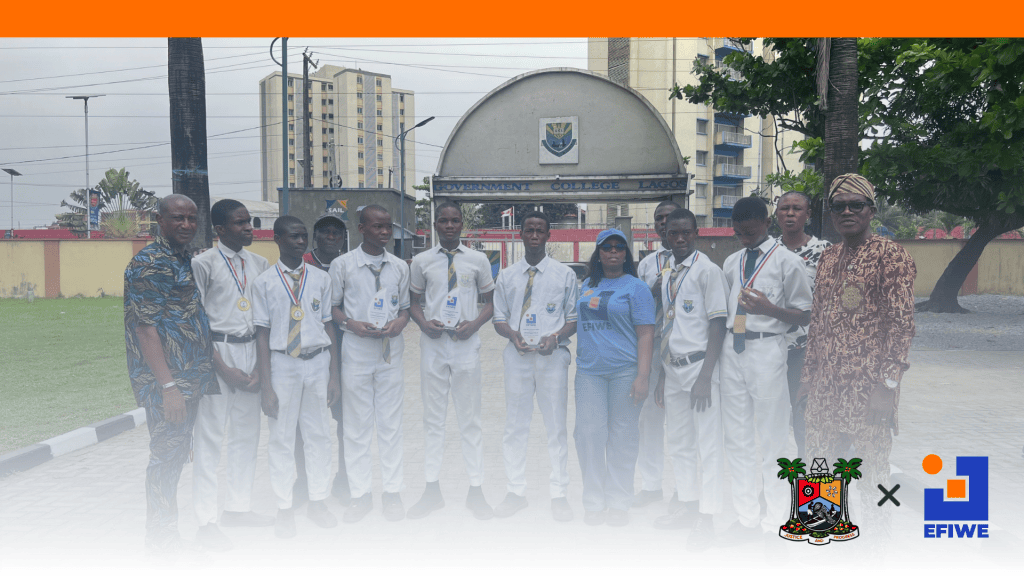
In September, 54 boys at Government College (Senior), Surulere, logged into Efiwe. Their assignment was the same one we gave the girls at New Era Girls’ School a month earlier: complete all 191 HTML challenges. Eleven boys did. Four of them then passed the HTML capstone, a test the New Era girls never had to sit, because it did not exist yet. Between them, the boys completed 3,563 challenges and earned 612,052 points.
Those are good numbers for a first cohort. They are also less than a third of what 41 girls completed at New Era (12,323 challenges). The gap is not at the top. It is in the middle: the typical New Era girl finished all 191 HTML challenges, while the typical Government College boy stopped at challenge 14.
This post looks at what happened, what it tells us, and what it does not.
The second school in Education District IV
In July we signed our first government partnership, with the Lagos State Government’s Education District IV. It brings Efiwe into five public senior secondary schools, one a month from August to December 2026. New Era Girls’ School went first, in August. Government College (Senior), Surulere, an all-boys school, went second, in September.
Both schools got the same setup: Efiwe on the phones students already had, working offline, with no laptops and no data bundle needed after the first load. The brief was the same: one course, HTML, 191 challenges.
The platform the boys met was a little different, because we kept shipping in between:
| Feature | New Era girls (August) | Government College boys (September) |
|---|---|---|
| HTML, CSS, JavaScript, Tailwind, Python, SQL courses | Available | Available |
| PHP course (launched August 18) | Available late in the month | Available |
| Prompt Engineering course (launched September 15) | Not yet | Available |
| Learning Modes: Beginner, Skipper, Explorer (September 18) | Not yet | Available |
| In-game dictionary (September 18) | Not yet | Available |
| Capstone project required for a certificate (September 20) | Not yet | Required |
| Reading levels and baseline/endline checks (October 25) | Not yet | Not yet |
The capstone is the big one. Every regular challenge shows a worked example a few lines above the editor. A capstone gives only a written brief, and the learner builds the page from scratch in the Efiwe IDE. It is graded by inspecting the page the browser actually built, not by our AI. That is why the New Era girls have no capstone results: it was introduced after they took the challenges.
What the boys did
Fifty-four accounts joined the Government College group, and 43 of them completed at least one challenge. Eleven boys finished all 191 HTML challenges: Stephen Emmanuel, Nwani Philip, Houndealo Felix, Kadiri Ayomide Ilerioluwa, Odoemelam Gideon, Kareem Waris Olamide, Ukandu Chinemerem, Eluji Destiny Chibuike, Owai Henry Prosper, Oladejo Olayiwola and Kamoru Abdulramon Temitope.
Four of them, Stephen, Nwani, Houndealo and Kadiri, then passed the HTML capstone. They built a working page from a written brief, with no worked example to copy. Two more boys came close to finishing: Nwokeji Johnpaul reached 143 challenges and Emmanuel Olatunji reached 133.
Nine of the 11 finishers kept going into CSS without being asked. None has finished its 298 challenges yet, but four have passed 100: Stephen (139), Eluji (110), Houndealo (103) and Nwani (100). Stephen has completed 330 challenges in total, the most in the cohort. One boy started Python and another started SQL, both on their own.
Where each learner stopped
Half the boys had stopped by challenge 14. Half the girls finished all 191.
Share of each school’s accounts that completed at least this many HTML challenges
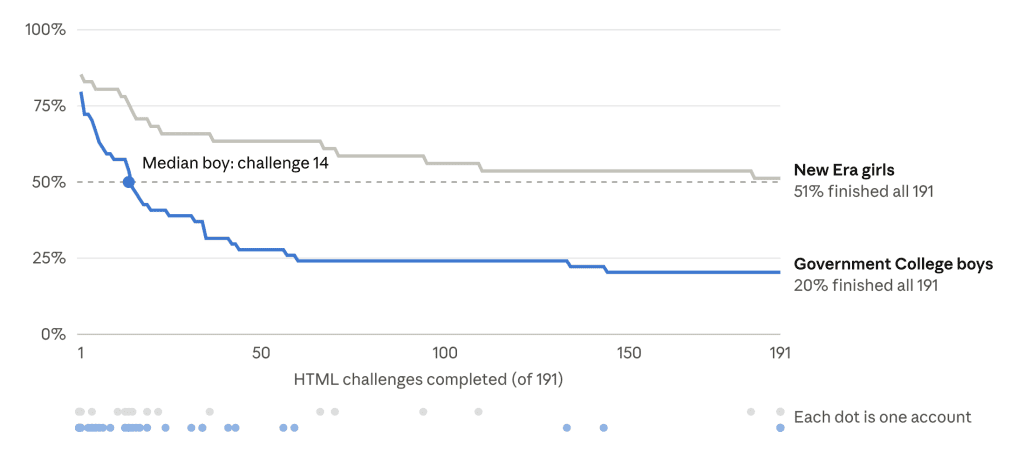
Both lines start in the same place: about four in five accounts completed at least one challenge. The boys’ line then falls steeply through the first 50 challenges, while the girls’ line levels off above half and stays there to the end.
Beyond HTML
The New Era girls started six courses. The Government College boys started three, and only CSS got real traction. Nobody in the boys’ cohort has started JavaScript or Tailwind yet, though both were available.
| Course | Challenges | Girls who started it | Girls who finished | Boys who started it | Boys who finished |
|---|---|---|---|---|---|
| HTML (assigned) | 191 | 41 | 21 | 54 | 11 |
| CSS | 298 | 22 | 10 | 15 | 0 (top reached 139) |
| JavaScript | 488 | 13 | 4 | 0 | 0 |
| Tailwind | 154 | 8 | 4 | 0 | 0 |
| Python | 420 | 5 | 0 (top reached 117) | 2 | 0 (top reached 4) |
| SQL | 251 | 1 | 0 | 1 | 0 (top reached 5) |
“Started it” counts accounts that appear in a course, so it includes a few who started a course without completing a challenge. Girls’ and Boys’ figures are from the end of their programme.
The New Era girls have not stopped. Two months after their programme ended, with nothing assigned, their total has risen from 12,323 to 12,390 challenges, and the girl furthest into Python has gone from challenge 117 to 124.
Side by side
The boys’ cohort was a third larger than the girls’, but the girls completed about 3.5 times as many challenges.
| New Era Girls’ School | Government College (Senior) | |
|---|---|---|
| Accounts in the group | 41 | 54 |
| Completed at least one challenge | 35 (85%) | 43 (80%) |
| Finished all 191 HTML challenges | 21 (51%) | 11 (20%) |
| Finishers as a share of those who started | 60% | 26% |
| Median HTML progress | 191 of 191 | 14 of 191 |
| Total challenges completed | 12,323 | 3,563 |
| Points earned | 1.87 million | 612,052 |
| Challenges per learner who started | 352 | 83 |
| Courses started | 6 | 3 |
| Most challenges by one learner | More than 1,200 | 330 |
| HTML capstone | Not yet available | 4 passed |
What this tells us about all-boys and all-girls schools
The honest answer is that two schools cannot tell us what gender does. They can tell us where the two rooms differed, and that is useful enough.
1. The top of both rooms looks alike. Eleven boys finished HTML, nine went straight into CSS, and four passed a capstone with no worked example to lean on. That is the same self-driven behaviour we saw at New Era. Both schools had a group of learners who ran as far as the platform let them, whatever the brief said.
2. The difference is in the first week. At New Era, the typical girl finished all 191 challenges. At Government College, 28 of the 54 boys stopped somewhere between their first and 49th challenge, and the typical boy stopped at 14. The gap opens early, long before the capstone or any other feature introduced between the two cohorts could matter. Only one boy used the new Skipper mode, so that does not explain it either.
3. Access was necessary, but it was not enough. In August we wrote that the constraint for the New Era girls “was never motivation. It was access.” Government College had the same access: the same phones, the same offline app, the same district, the same brief. The results were different. So something in the room matters as well: how sessions run and who is in them.
4. We cannot say that “it is because they are boys”. Many things differ between two schools besides gender: how students were selected, the teacher or facilitator, how often sessions actually happened, how many students share each phone, and what else was on the school calendar in the first weeks of a new term. Any of these could produce a gap this size. Drawing a lesson about boys from one school, or about girls from another, would be overreading the data.
What we will change. These are things we will try, not conclusions:
- Get everyone past challenge 50 in the first two sessions. That is where most of the boys stopped. We will use the group dashboard, which shows where each learner stopped, to follow up within days rather than at the end of the month.
- Pair learners who are moving with learners who are not. Eleven boys finished. Each could help two or three classmates through the early levels.
- Say at the start what will be recognised. At both schools the awards came at the end. Next time every school will know from day one what counts, including the capstone.
- Offer Simple Language from the first session. Since October 25, every challenge can be read in Simple Language, with short sentences and everyday words, while the code and the answers stay the same. The early HTML challenges carry a lot of reading and very little code. We do not know whether wording is why learners stopped there, but now we can test it.
- Measure learning, not just completion. Since October 25, every learner takes a 12-question baseline check before a course and a matching endline before the capstone. Together with the time on task and attempts per challenge we have recorded since October 4, the next schools will show how much learners grew, and whether those who stop do so because a challenge is hard or because they stopped opening the app.
What this data cannot tell us
- One school of each. Any difference between New Era and Government College could come from the school rather than from gender.
- Results, not reasons. We know how many challenges each learner completed, not how much they learned, how many sessions they attended, how long they spent, or whether they shared a phone. From the next school onward, the baseline and endline checks launched on October 25 will show learning gains, and the learning history added on October 4 will show time on task and attempts per challenge.
The awards
As at New Era, we presented awards to the top three performers in HTML and medals to the top ten. This time the ranking had one more step. Learners who passed the HTML capstone were ranked first, then everyone was ordered by score. A learner who built a working page from a brief, with no worked example, ranks above one who scored more on the challenges alone.
Awards
- Nwani Philip
- Houndealo Felix
- Stephen Emmanuel
Medals
- Kadiri Ayomide Ilerioluwa
- Odoemelam Gideon C.
- Kareem Waris Olamide
- Ukandu Chinemerem
- Eluji Destiny Chibuike
- Owai Henry Prosper
- Oladejo Olayiwola
Congratulations to all ten. And to Kamoru Abdulramon Temitope, who completed the full HTML course without placing in the top ten, and to every boy who opened the app and completed his first challenge: you are part of this result too.
What comes next
Three more Education District IV schools complete the rollout this term: Eric Moore Senior High School, under way this month, Itolo Girls’ Senior Secondary School in November, and Surulere Senior Secondary School in December. Itolo matters most for this question. It is a second girls’ school, so it will show whether the New Era result repeats or whether New Era was a particularly strong room. From October 25, the baseline places experienced learners at Intermediate or Advanced and passes over the challenges below their level, so a total for Eric Moore or Itolo does not mean the same thing as a total for New Era or Government College. We will compare HTML completion and, for the later schools, how far each learner moved from baseline to endline.
If you run a school, a district, or a programme for young people in Nigeria and want to bring Efiwe into your classrooms, we would like to hear from you.
or