

Most software written from today onward will be written with an AI in the loop. The person typing is no longer only a coder. They are the one deciding what gets built, what it must not do, what happens when it fails, and whether what came back is safe to ship. That decision-making happens in a text box, and almost nobody has been taught how to use it.
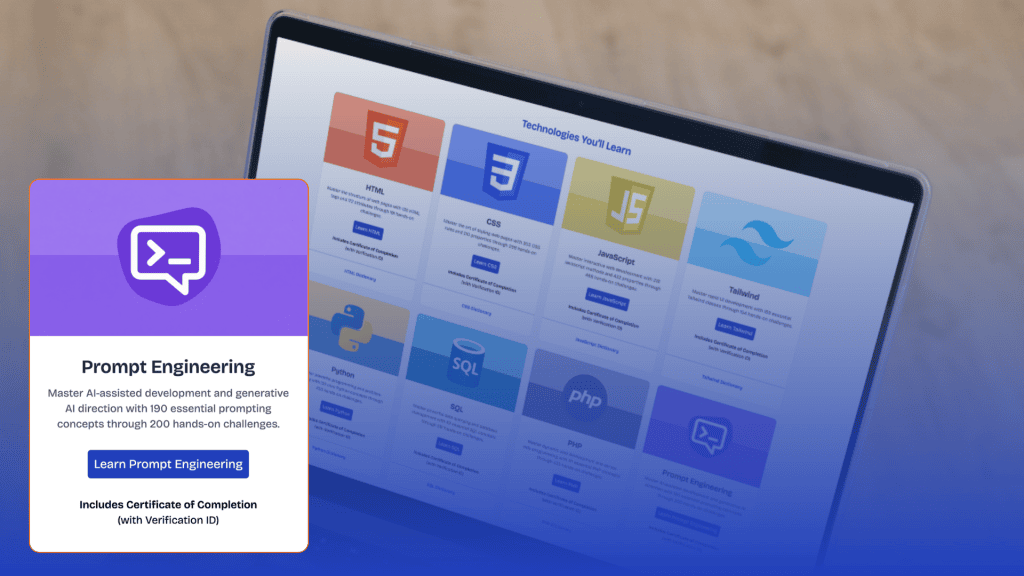
With this launch, Efiwe’s curriculum now spans eight courses: HTML for structure, CSS for design, JavaScript for interactivity, Tailwind for professional styling, Python for logic and automation, SQL for working with data, PHP for the server side, and now Prompt Engineering for directing AI to build real, secure, scalable products.
The Prompt Engineering course is built around 200 challenges spanning 60 easy, 60 intermediate, and 80 advanced challenges. Every challenge is a prompt to write, not a video to watch or a paragraph to read. The course opens with a single instruction to an AI and builds steadily through naming the language and the tool, saying what goes in and what comes out, replacing vague words with exact ones, showing examples, stating what you do not want, and defining what should happen when something goes wrong. From there it moves into common product features: forms and validation rules, loading and empty and error states, lists with sorting and search and paging, editing and deleting, money and dates, uploads and messages.
The middle of the course is about context. A whole section is devoted to onboarding an AI to a codebase that already exists: naming your framework and database, saying what is already built, pasting the right amount of code and no more, describing your folder layout and data shape, stating what you cannot change, and saying what you already tried. Then planning before code, where learners agree a data shape and an interface up front, ask for trade-offs, ask what could go wrong, work one step at a time, and stop a runaway answer before it becomes a day of cleanup.
The advanced half is where the course stops being about getting an answer and starts being about being responsible for it. Learners work through reviewing AI-written code, spotting invented functions and packages, feeding an error back usefully, and knowing when the AI is simply wrong. Then a full section on security, beginning with why AI writes insecure code by default and moving through permissions, sessions and tokens, hashing, SQL injection in code you already have, allow lists, rate limiting, secrets leaking into the front end, prompt injection in your own product, and what happens when an AI is given access to your database. After that come usability, offline behaviour and slow connections, scale and slow queries and queues, cost per user, monitoring, deployment and rollbacks, technical debt named honestly, and a capstone that runs a secure, scalable feature end to end.
Each of the ten sections closes with a “Put it together” challenge that asks the learner to write one complete prompt combining everything the section taught.
The engine behind the course is the part that had to be invented. Every other Efiwe course compares a submission to a reference solution, but two prompts that share no wording can both be excellent, so string comparison would only reward memorising the answer. The on-device validator does not ask whether a model would produce good code from this prompt, because that question needs a model and therefore a connection. It asks whether the prompt contains the ingredients that correlate with good code, which is decidable on the device, deterministically, and is the more teachable question anyway.
Every challenge is fully playable, scorable and completable with no network at all.
Making that work in 246 languages meant fixing things that only break outside English. Numbered lists written in Arabic-Indic or Devanagari numerals were being read as unstructured prose. Worse, Chinese, Japanese, Thai, Khmer, Lao, Burmese and Tibetan do not separate words with spaces, so a thorough 300-character Japanese prompt was counted as one word and rejected outright as too short to be specific, often while being better than the English prompts that passed. Both are fixed.
The middle panel that holds accumulated code in other courses holds a Prompt Library here. Every prompt a learner gets right is saved, building into a personal reference of patterns that worked, in their own words, ready to reuse on real work.
Learners who complete the course earn a certificate as a Junior, Mid-Level or Senior Prompt Engineering Developer depending on points earned, verifiable and shareable.
“Prompt engineering is not a trick or a trend, it is the interface to the most productive tool any developer will ever hold,” said Abhinav Negi, Co-founder and CEO. “A learner who can direct an AI precisely can build in a weekend what used to take a team a month. What we kept seeing is that the gap between people getting extraordinary results from AI and people getting slop is not access to the AI. Everyone has that. It is knowing what to say. That is a teachable skill, and now it is taught.”
“The hard part was that you cannot grade a prompt by comparing it to a model answer, and you cannot grade it by running it through an AI, because that needs a connection our learners do not always have,” said Chidi Nwaogu, Co-founder and CTO of Efiwe. “So we built a linter for prompts. It reads what you wrote, works out what you asked for and what you left out, and tells you where it will break, all on the phone, with the network off. The other thing we insisted on is that this course is not about getting an answer out of an AI. It is about being accountable for what the AI hands you. Half the course is security, review and scale, because that is the half that decides whether what you built survives contact with real users.”
The Prompt Engineering course also inherits all of Efiwe’s accessibility features.
With Prompt Engineering, Efiwe’s curriculum now covers eight interconnected courses, spanning front-end development, back-end logic, data, and the skill that ties all of them to the way software is actually built now, built entirely for smartphones, entirely offline, entirely free.
A course on React is planned for the coming months.
Start the Prompt Engineering course at efiwe.com/prompt
or