

The mobile-first coding education platform expands its reach with Efiwe Zero; an SMS bot that lets anyone learn to code using only a phone number and a text message, building on the Open API and messaging integrations it launched earlier in 2026.
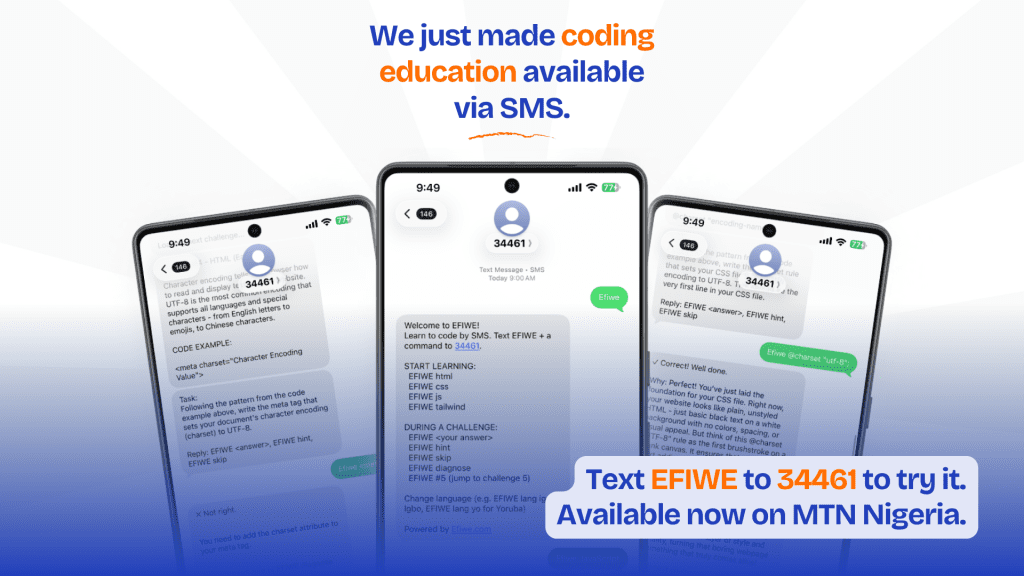
Efiwe, the mobile-first coding education platform serving over 11,000 learners across 139 countries, has extended its learning experience to SMS, the world’s most universally available messaging channel, allowing anyone to learn to code with nothing more than a basic phone and a text message. Starting today, MTN users in Nigeria can text EFIWE to shortcode 34461 and immediately begin solving real interactive coding challenges, receiving AI-powered hints, and getting instant feedback on their code, all within a standard SMS conversation, with no internet required, no app to download, and no account to create.
The product is called Efiwe Zero, named after the idea that the barrier to starting should be zero. A feature phone is enough. A basic SIM card is enough. A single text message is enough to begin. Users select a topic (HTML, CSS, JavaScript, or Tailwind), receive a challenge directly in their messages, submit their code as a reply, and receive instant AI-powered feedback, exactly as they would on the main Efiwe platform or in its WhatsApp and Messenger bots. The bot remembers where a user is within a session, presents challenges progressively, and loads the next one automatically once a correct answer is submitted.
This launch is a direct extension of the Efiwe Open API, which launched in January 2026 and was designed specifically to allow third-party platforms to embed Efiwe’s interactive coding challenges into their own products. Like the Messenger and WhatsApp bots before it, Efiwe Zero is built entirely on top of that API, using the same challenge delivery, code validation, hint generation, and AI-powered diagnostics that power the main Efiwe platform. In this sense, Efiwe Zero is not a separate product. It is the Open API’s thesis taken to its logical extreme: if world-class coding education can be embedded in any platform, it can be embedded in SMS, the oldest, most universally available digital communication channel on earth.
“Efiwe was built on the belief that the barrier to coding education should be zero,” said Chidi Nwaogu, Co-founder and CTO of Efiwe. “WhatsApp reaches billions, but it still requires a smartphone and a data connection. SMS reaches everyone, including the learner who has a feature phone, no data plan, and five minutes between tasks. That person deserves the same quality of education as anyone else. Efiwe Zero is for them.”
The context behind that statement is concrete. Over 4 billion people worldwide primarily rely on smartphones or feature phones, and most live in regions where internet access is expensive, unreliable, or both. Nigeria alone has over 100 million active SIM cards, many on networks where data is a significant daily expense but SMS is cheap, immediate, and always available. For a learner in that environment, Efiwe Zero eliminates the last remaining condition attached to starting: an internet connection. The learning happens entirely within the SMS conversation, at the cost of a standard text message.
Building for SMS required thoughtful adaptation. Unlike WhatsApp or Messenger, SMS has no buttons, no interactive menus, no rich formatting, and a 160-character hard limit per segment. Every design decision had to serve clarity within those constraints. Challenges are delivered across two SMS messages to preserve natural reading flow: the introduction and learning context arrive first, giving the learner time to absorb the concept before the task lands in a second message. No content is truncated; if an explanation is 400 characters, it arrives in full across multiple segments, stitched together by the network into a single readable message on the user’s phone. The experience is designed to feel as close to a natural conversation as SMS allows, with the bot guiding the user through each step and every response reminding them how to proceed.
The AI feedback that defines Efiwe’s main platform travels intact to Efiwe Zero. When a user submits code, the bot validates it against the expected solution and generates a short, context-aware sentence of feedback using the cloud-based Efiwe 2.0 model. If the cloud AI is unavailable, the system falls back seamlessly to the on-device Efiwe 1.0/1.5 model, ensuring learners always receive a response. The same layered fallback logic applies to hints and code diagnosis. Users can request a hint at any point, ask the bot to diagnose a specific issue in their submitted code, skip a challenge, or jump directly to any challenge number, all using simple prefixed commands that the bot teaches clearly from the first interaction.
“What excites me most about Efiwe Zero is that it closes the loop on a question we have been sitting with since we started,” said Abhinav Negi, Co-founder and CEO of Efiwe. “We built Efiwe to work offline. We built it to work on any smartphone. We built it to work in 189 languages. But we were still asking learners to have a phone capable of running a browser. Efiwe Zero removes that. A text message is the most primitive form of digital communication, and now it is enough to start learning to code.”
The timing of this launch reflects a broader strategic direction for Efiwe. The Open API was built explicitly so that schools, NGOs, bootcamps, and developers could embed Efiwe’s curriculum into their own platforms without rebuilding its technology. The Messenger and WhatsApp bots demonstrated that this integration could reach into the messaging layer of the internet. Efiwe Zero demonstrates that it can go further still, into the network layer, reaching devices and communities that messaging apps do not. For learners in communities where a smartphone is a luxury and a feature phone is the reality, this means coding education is now available in the most accessible place imaginable: their inbox.
Efiwe Zero is available now on MTN Nigeria. Users can start immediately by texting EFIWE to 34461. The service is free to use, and standard SMS rates apply. Coverage will expand to additional Nigerian networks and other countries as Efiwe Zero scales. Efiwe’s Messenger bot is accessible by messaging the Efiwe Facebook Page, and the WhatsApp bot by messaging the Efiwe WhatsApp Business number. Both bots, like Efiwe Zero, are free to use and require no account creation, no downloads, and no prior coding experience to get started.
or